
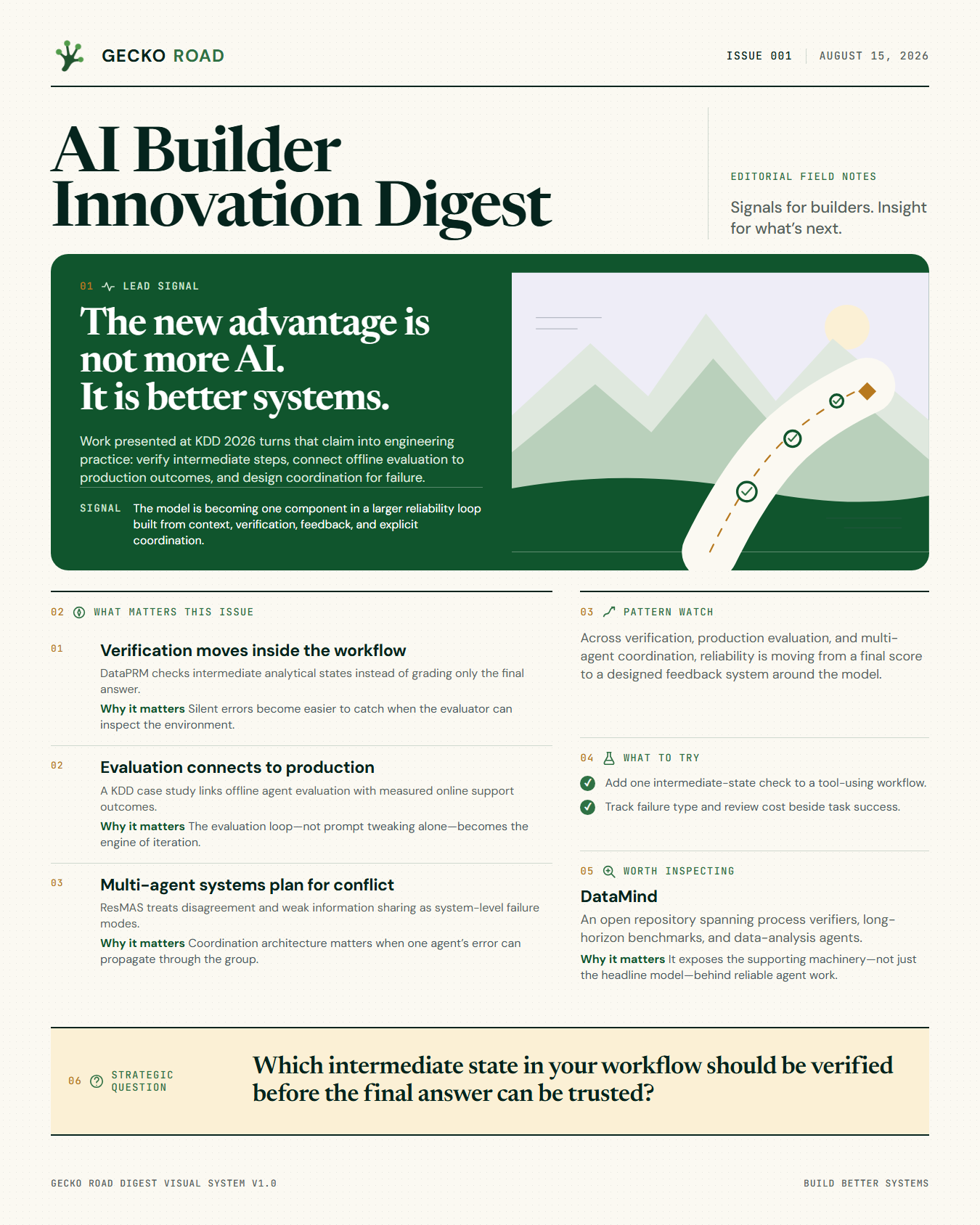
This was a quiet publication window with one unusually coherent signal. The final day of KDD 2026 brought together work on process verification, production evaluation, and multi-agent robustness. The papers were available before August 13; the timely event was their presentation within the conference program, not their first release.
That distinction matters. This Digest is not stretching three older papers into three unrelated news stories. It is using one current gathering to examine a shared engineering direction.
The one thing that matters
The new advantage is not more AI. It is better systems.
Gecko Road has already argued that model power is only one part of business value and that everyday AI use becomes a capability only when the surrounding workflow is dependable. The KDD work does not replace those arguments. It makes the required machinery more concrete.
In each of this issue’s three stories, the model is necessary but insufficient:
- a data-analysis agent needs a verifier that can inspect intermediate work;
- a production support agent needs an evaluation loop tied to live outcomes; and
- a multi-agent system needs a way to negotiate conflicts and preserve useful information.
The common move is from evaluating an answer after the fact to designing a feedback system around the work as it happens.
Stories worth your time
Process verification moves inside the workflow
Many agent evaluations ask whether the final answer is correct. That can miss the steps that produced it. A data-analysis agent may use the wrong column, quietly lose rows, misuse a tool, or make an exploratory move that looks unproductive until later. The final response does not expose all of that state.
The DataPRM paper presented at KDD 2026 treats verification as an active part of the process. Its verifier can inspect the execution environment and take actions to gather evidence before assigning a score to an intermediate step. The authors describe it as a 4-billion-parameter process reward model designed specifically for agentic data analysis.
On two benchmarks, the authors report that using DataPRM for Best-of-N selection improved results by 7.21 percentage points on ScienceAgentBench and 11.28 points on DABStep. Those are research-team results, not an independent validation or a promise that the same gains will transfer to another workflow. The more durable idea is architectural: when the important evidence lives inside the environment, the evaluator needs access to that environment too.
For builders, this suggests a sharper question than “Was the final answer good?” Ask which intermediate state would reveal that the system is already off course. A retrieved record, generated query, tool result, calculation, or policy selection may be more diagnostic than the prose at the end.
Builder implication: place verification where silent errors become visible, not only where the user sees the finished output.
Production evaluation becomes the iteration engine
The second signal comes from a Nubank case study on evaluating customer-support agents in production. The work describes a unified context-engineering and evaluation framework across five support domains, combining human prompt iteration, calibrated LLM judges, offline tests, and online validation.
In a card-delivery deployment, the authors report a 37-percentage-point lift in transactional Net Promoter Score and a 29-point lift in self-service rate compared with prior agent variants. Those numbers are case-specific and author-reported. They should not be generalized into expected returns for another company, channel, or customer population.
What is broadly useful is the connection between offline and online evidence. An offline evaluator can make iteration faster, but only if it is calibrated against judgments and outcomes that matter in the real operation. Online results can show whether customers and the workflow actually improved, but they arrive too slowly and expensively to guide every prompt or context change. The two loops serve different speeds.
This turns evaluation from a release gate into operating infrastructure. The system can move quickly because it has a fast loop for candidate changes and a slower loop that checks whether those changes survive contact with production.
Builder implication: define how offline scores will be calibrated and how production outcomes will correct them before treating an evaluator as authoritative.
Multi-agent systems need explicit conflict design
Adding agents can create useful specialization. It can also create more places for an error to spread.
ResMAS starts from two failure modes in LLM-based multi-agent systems: agents can take conflicting actions, and useful information can be lost or poorly shared. The proposed system combines action negotiation with selective information-sharing redundancy. According to the authors, the approach was evaluated across seven datasets and thirteen baselines and improved robustness under adversarial conditions.
Again, the exact gains belong to the reported experiments. The practical signal is the failure model. A multi-agent architecture does not become reliable simply because several agents can vote or talk to one another. Builders have to decide what happens when proposed actions conflict, which information deserves redundancy, and how the system contains one participant’s bad state.
This is a useful correction to architectures that treat coordination as message passing alone. Communication is not the same as resolution. Redundancy is not automatically resilience. Both need to be aimed at specific failure paths.
Builder implication: before adding another agent, write down the conflict it could introduce, the evidence used to resolve it, and the boundary that stops its error from propagating.
The pattern
All three stories move reliability closer to the work:
- DataPRM evaluates intermediate actions with access to the environment.
- The production support framework connects fast offline judgments to slower online outcomes.
- ResMAS handles disagreement and information loss within the coordination layer.
That is a more useful pattern than “agents are getting better.” It says reliability is becoming a designed feedback system around the model.
This expands the system-over-model thesis in a specific way. Context, workflow, ownership, and review still matter. But builders can now ask where those operating requirements should become technical checkpoints. The answer may be a process verifier, a calibrated judge, a live outcome measure, an escalation rule, an action negotiation step, or a deliberately redundant information path.
The right mechanism depends on the consequence of failure. A low-risk drafting aid may only need sampling and human review. A tool-using analytical workflow may benefit from checking a query or transformation before the final narrative is written. A production agent taking consequential actions needs stronger evaluation and containment.
Complexity still has to earn its place.
Builder’s corner
The artifact worth inspecting is DataMind, the open repository associated with DataPRM and a broader body of work on data-analysis agents.
The repository is useful because it exposes more than a headline model. It connects agent implementations, process verification, and evaluation work in one place. That makes it possible to inspect the supporting machinery and the assumptions around it.
One related project in the repository is LongDS-Bench, a long-horizon data-science benchmark. It is companion context rather than a new KDD announcement. The authors constructed 68 tasks covering 2,225 interaction turns across six domains. Their reported results show that the strongest tested model completed 48.45% of the benchmark, with performance falling sharply from early to late stages. They also report that simply taking more steps does not reliably improve outcomes.
That finding reinforces this issue’s theme: a longer trace or larger agent loop is not the same as a better system. Inspect how the repository represents state, tools, intermediate outputs, and evaluation. Those interfaces are likely to teach more than the top-line score.
Ideas worth stealing
Give the verifier the evidence it needs
If correctness depends on a database result, retrieved document, calculation, or tool state, do not ask an evaluator to infer that evidence from the final prose. Give it bounded access to the relevant state and log what it checks.
Run fast and slow evaluation loops
Use a fast offline loop to compare candidate changes, then a slower operational loop to test whether the selected change improves the outcome people actually experience. Track disagreement between the loops; it is information about the evaluator, not noise to hide.
Spend redundancy on named failure paths
Do not duplicate every agent or every message. Identify where information loss or one bad action would be expensive, then add a second source, confirmation step, negotiation rule, or human escalation at that point.
Experiments worth running
Add one intermediate-state check
Choose a tool-using workflow and identify one state that must be correct before the workflow continues: the selected source, query, retrieved record, calculation, or proposed action. Capture it, apply a simple deterministic or human-reviewed check, and measure how often it catches a problem that the final-output review missed.
Keep the experiment narrow. The goal is to learn whether earlier evidence reduces silent failures, not to build a universal verifier.
Track failure type and review cost beside task success
For one existing evaluation set, add two fields: the failure category and the time required for a person to review or correct the result. A single success rate can hide a workflow that technically completes but creates expensive cleanup.
After a small sample, look for concentration. If one failure type creates most of the review burden, improve that part of the system before changing the underlying model.
What I’m watching
Three questions will determine whether this direction becomes broadly useful:
- Can process verifiers remain reliable when they inspect unfamiliar tools and environments?
- Do calibrated LLM judges continue to track human and business outcomes as products, policies, and customer behavior change?
- Can multi-agent robustness mechanisms improve resilience without adding more latency, cost, and coordination failure than they remove?
There is also a governance question beneath all three. A verifier or judge can concentrate authority while appearing objective. Builders need to know what evidence it saw, where it is weak, and who can override it.
Take this with you
The most important question from this cycle is not which model won.
It is this:
Which intermediate state in your workflow should be verified before the final answer can be trusted?
Answer that for one real workflow. It will tell you more about the system you need than another model comparison.
Sources
- KDD 2026 schedule at a glance, including the August 13 oral sessions and closing address.
- DataPRM: An Active Environment-Aware Process Reward Model for Agentic Data Analysis, KDD 2026.
- Context Engineering and Agent Evaluation for AI-Powered Customer Support, KDD 2026.
- Robust LLM-Based Multi-Agent System with Action Negotiation and Selective Information Sharing, KDD 2026.
- DataMind repository, including DataPRM and related data-analysis-agent projects.
- LongDS-Bench: Are Agents Really Long-horizon Data Scientists?, companion research referenced in Builder’s Corner.
Evidence note: Research metrics and production outcomes in this issue are reported by the respective authors and have not been independently validated by Gecko Road. The papers were publicly available before the August 13-15 coverage window; their inclusion is based on presentation and synthesis at KDD 2026. Builder implications, the cross-story pattern, and the proposed experiments are Gecko Road analysis.